New ideas need time to prove their merit. Unfortunately, we live in a world of snap judgments.
When Chianti Classico added the Gran Selezione category to its guidelines in February 2014, it was greeted with a fair amount of skepticism in certain circles. Did the world of Chianti really need another layer of categorical complexity? Weren’t they just adding a new super category on top of Riserva so that the wines would cost more?
The wines are better than before, they are more specific than before, and they have an exciting amount of vintage variation. Add those three things together and you get “fine wine.” Which is pretty much what they set out to do in 2014: change the conversation.
Producers weren’t necessarily united either. For some of the GS holdouts, the six months of added aging over Riserva didn’t amount to much. Still others found that the stricter blending formula didn’t allow for the blend of their already established top wine. Some just wanted to take it slow and see how the category was received by the public before diving in.
But with time, this category has more than proved itself to the doubters, myself included. Far from tasting like a cynical cash grab, they mostly taste generous yet complex, lively and unique from one to the next. Each February when I arrive in Florence to taste the new offerings at the Chianti Classico Collection, I can’t help but put the Gran Selezione first on my tasting schedule. While my palate is fresh, I want to get into the specifics of vintage and vineyard, and explore the exciting details.
Enthusiasm for the Gran Selezione has swelled, and all but killed the media trope of starting any Chianti Classico article with a reference to fiaschi (“Remember those straw-basket bottles? This isn’t your parents Chianti!” We’ve all read it a hundred times …) The U.S. is still Chianti Classico’s top export market, and here, I can testify that curiosity about the Gran Selezione has gone far beyond the coasts. There is even a regular Chianti Classico event in Denver, where I live, with visiting producers and masterclasses centered on the category and what it says about the nuances of the territory.
So How Did We Get Here?
The timing of the Gran Selezione launch proved fortuitous, as decades of clonal research on Sangiovese was “coming online” in the vineyards around the appellation. Better clones suited to the specifics of site meant better results.
Additionally, Italian wine lovers were ready for wines of distinction and poise, not imitations of an international style. With its embrace of 90% Sangiovese, the category’s parameters naturally allowed for this. Soon, Gran Selezione not only became shorthand for “tip top,” but also “single vineyard expression.” Most wines now filed in this category come from the best performing individual parcels, and carry the name of such a site.
To better serve this trend, the consorzio and its partners spent years mapping and documenting the area’s complex soil structures and terroir, leading to the creation of 13 subzones, better known by their bureaucratic, dull-as-wallpaper paste name of UGA (Unità Geografiche Aggiuntive, or “additional geographical units”).
Essentially, the UGA are villages. Some have a strong winemaking identity that feels every bit driven by culture as terroir. For instance, you can explain Lamole by its high altitude and cool climate, or its scrappy sense of self-reliance. Panzano can be appreciated for combining all of Chianti Classico’s terroir elements into one place, or for its united-front community of producers. Either storyline is correct, and it is not the media telling it. Instead, it is the wines doing the talking.
To me, this is the vision of Gran Selezione in action, and because of that, the higher price tag is worth it. The wines are better than before, they are more specific than before, and they have an exciting amount of vintage variation. Add those three things together and you get “fine wine.” Which is pretty much what they set out to do in 2014: change the conversation. You can do that in the short term by inventing a new category and term, but long term, that discussion withers without genuine results.
Below are the Gran Seleziones that, at least this year, walk the walk and talk the talk.
Navigate This Guide
It is worth noting that producers can opt to age the wines longer than the minimum, and many do. As a result, this report on new releases features three different vintages: 2022, 2021 and 2020.
- Top Wine
- Cellar Pick
- A True Classic
- Most UGA-Centric
- Best Invitation to Visit Chianti
- Most Terroir-Driven
- The Returning Champ
Alphabetical
- 2021 Arillo in Terrabianca “Vigna Terrabianca” Chianti Classico Gran Selezione
- 2022 Calcamura Chianti Classico Gran Selezione
- 2022 Castello di Ama “San Lorenzo” Chianti Classico Gran Selezione
- 2021 Castello di Monsanto “Il Poggio” Chianti Classico Gran Selezione
- 2022 Castello di Volpaia “Il Puro Casanova” Chianti Classico Gran Selezione
- 2022 Fontodi “Pastrolo” Chianti Classico Gran Selezione
- 2022 Fontodi “Terrazze San Leolino” Chianti Classico Gran Selezione
- 2022 Fontodi “Vigna del Sorbo” Chianti Classico Gran Selezione
- 2022 Istine “Casanova dell’Aia” Chianti Classico Gran Selezione
- 2022 La Vigna di San Marino ad Argiano Chianti Classico Gran Selezione
- 2021 Monteraponi “Bragantino” Chianti Classico Gran Selezione
- 2022 Querceto di Castellina “Sei” Chianti Classico Gran Selezione
- 2020 Rocca di Montegrossi “Vigneto San Marcellino” Chianti Classico Gran Selezione
- 2022 Villa Calcinaia Conti Capponi “Contessa Luisa” Chianti Classico Gran Selezione
- 2022 Villa Calcinaia Conti Capponi “La Fornace” Chianti Classico Gran Selezione
- 2022 Villa Calcinaia Conti Capponi “Vigna Bastignano” Chianti Classico Gran Selezione
Top Wines: 2022 Villa Calcinaia – Conti Capponi “Contessa Luisa” Chianti Classico Gran Selezione
2022 Villa Calcinaia – Conti Capponi “La Fornace” Chianti Classico Gran Selezione
2022 Villa Calcinaia – Conti Capponi “Vigna Bastignano” Chianti Classico Gran Selezione
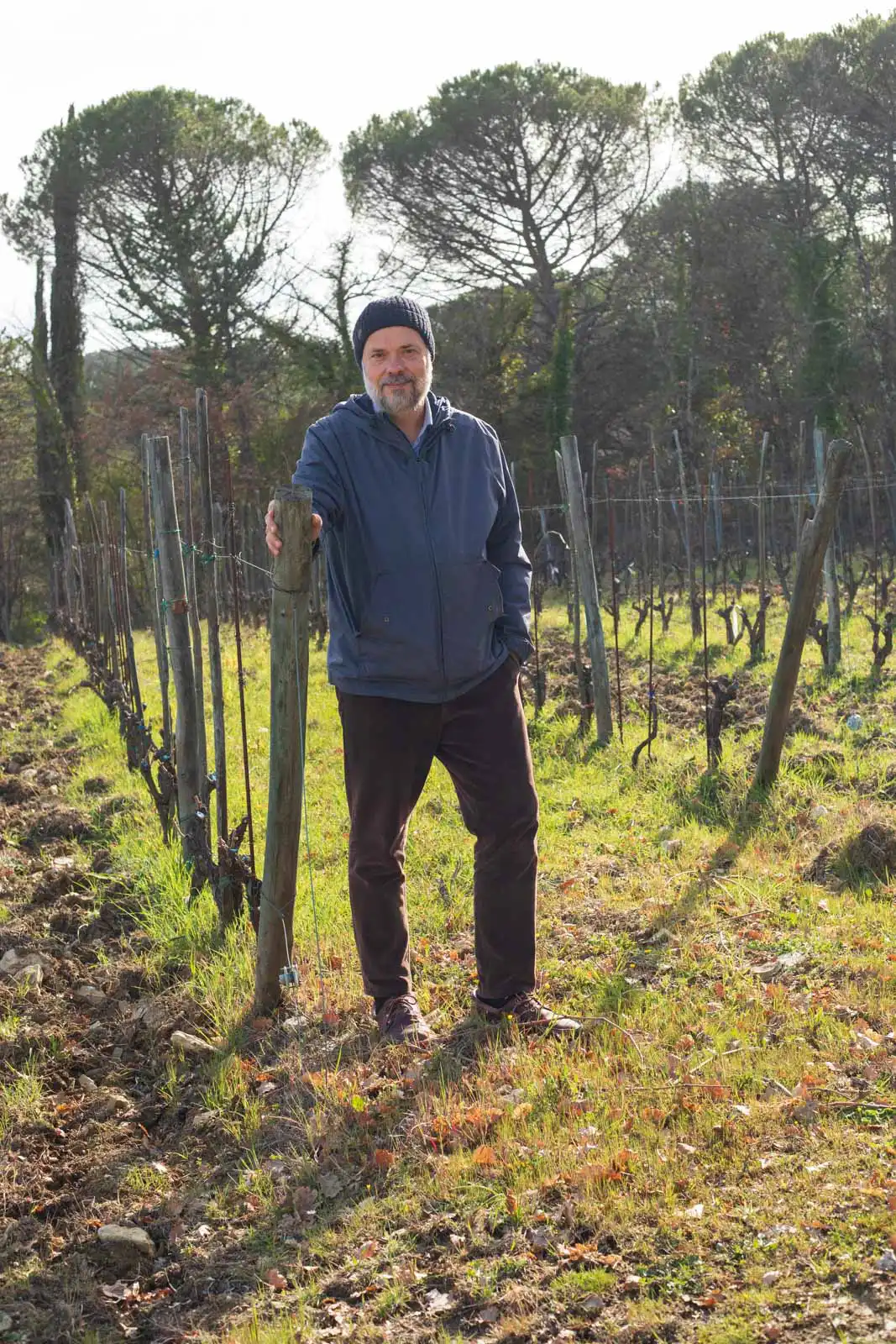
Winemaker Sebastiano Capponi is as dapper as they come: tweed jacket, wool vest, thick Windsor knot, trimmed beard. He seems to lean into his title of Count with relish, but he is not playing dress up. He embodies nearly 1,000 years of family heritage in the area (no, I did not type an extra zero, one thousand), and he takes his role as an ambassador of Tuscan taste very seriously. He counters this gravitas with a silly sense of humor and a twinkle in his eyes.
If tasked with pointing out a single example of the Gran Selezione vision being realized at the 2026 Chianti Classico Collection, I would point to Sebastiano’s wines.
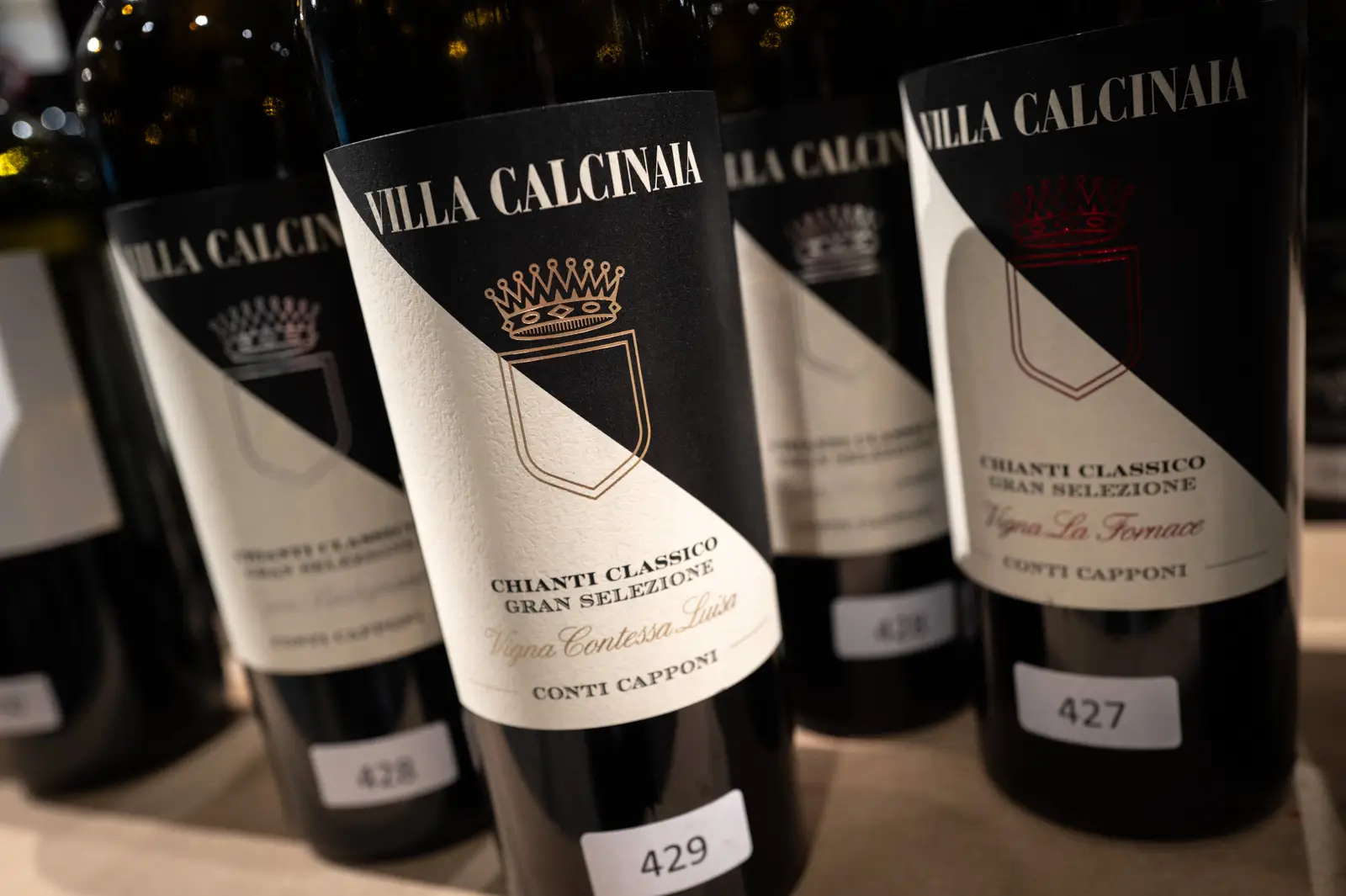
Villa Calcinaia – Conte Capponi lies in the Montefioralle UGA, and for years now, the estate’s trio of single-vineyard, 100% Sangiovese wines has offered clear evidence that this great grape can express terroir. At this tasting, Contessa Luisa, La Fornace and Vigna Bastignano offered the most complete spectrum of taste, terroir narrative, and aging potential.
Sebastiano has good reason to separate the three. Contessa Luisa comes from the oldest vineyard, with vines dating back to 1959 — a peculiar rarity in this ancient region where you’d expect old vines would be the norm (they’re not). The vineyard’s roots are firmly held by a strong clay composition. La Fornace’s unique character is derived from its proximity to the Greve River and thus its sandy soils. Meanwhile, Vigna Bastignano, often the strongest of the three, comes from a clay-limestone amphitheater — a satellite dish for solar energy that transmits power in the glass.
The 2022 Contessa Luisa should suit those with Burgundian inclinations: it is floral while retaining Sangiovese’s savory soul, and ever-so-refined on the palate (it earned my top score of all Gran Selezione wines). The 2022 Vigna Bastignano leans more to the savory side of things, with already-silky tannins countered by that signature potency of site, suggesting long aging potential. Meanwhile, the 2022 La Fornace feels like the middle ground: an artful balance of savory cherry, resinous herb and citric sensations, all swathed beautifully in velvety tannins and mineral persistence.
I’ve had Villa Calcinaia listed as an Essential Winemaker of Italy for nearly seven years now. There’s no reason to believe this vital, under-the-radar winery won’t make it to the ten-year mark.
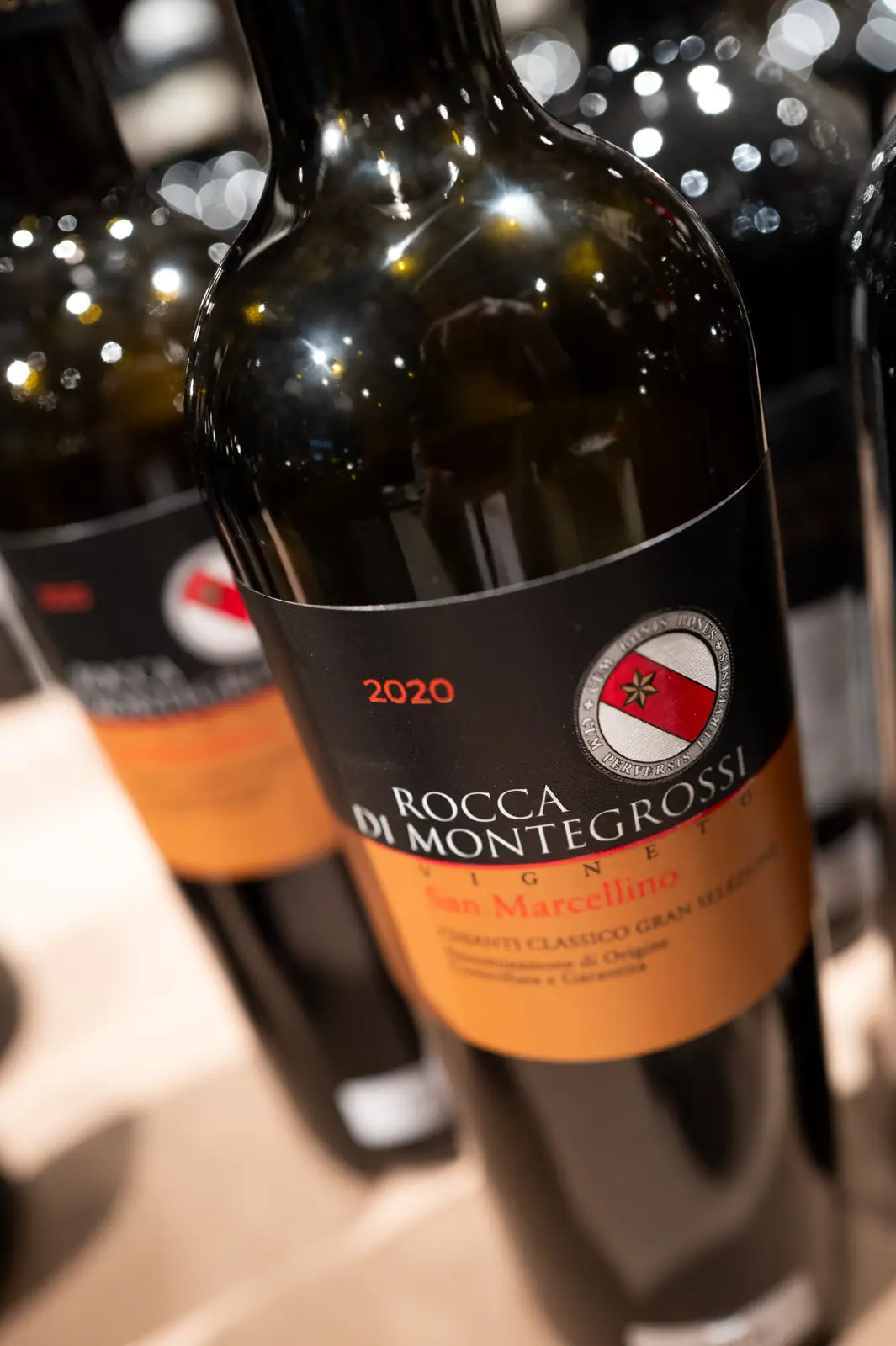
Cellar Pick: 2020 Rocca di Montegrossi “Vigneto San Marcellino” Chianti Classico Gran Selezione
For three years running now, I’ve attended the Chianti Classico Collection, and whenever a bottle of Rocca di Montegrossi arrives at my tasting table, I feel re-energized. This Gaiole UGA estate has Ricasoli roots: current winemaker Marco Ricasoli-Firidolfi is five generations removed from the “Iron Baron” who pioneered the Chianti blend in the 19th century. But in the glass, Rocca di Montegrossi’s wines are vastly more energetic and dynamic than the well-crafted but even-mannered wines of Ricasoli (the estate more closely associated with the baron’s progeny).
The 2020 “Vignette San Marcellino” throttled me back to attention just as my afternoon energy was ebbing. It’s stern, leathery aromas and savory traits felt hauntingly beautiful and compelling, and for all the elegance of fruit on display in the mid-palate, its steely structure suggested that it best be laid down for a few years before re-opening.
A True Classic: 2021 Castello di Monsanto “Il Poggio” Chianti Classico Gran Selezione
Whereas Villa Calcinaia – Conte Capponi offers the fully realized “vineyard comparison” side of the Gran Selezione category, Fabrizio and Laura Bianchi of Castello di Monsanto always set the benchmark for singularity of site with “Il Poggio.” There is a certain comfort for me in tasting this reliable yet unique wine every year. But this is also countered by a certain writerly angst: what can I say about “Il Poggio” that I haven’t before?
How about this? Il Poggio connects with me the same way that eye-contact in a conversation does. It is deep, profound and unafraid of where things are headed. It opens itself up to you, and you find yourself opening up to it. What separates this wine from Castello di Monsanto’s Riserva — and really any other wine in the area — is the salty persistence of the finish. If that swirling, savory, citric nose is the conversation starter, the finish is what keeps the tête-à-tête going all night.
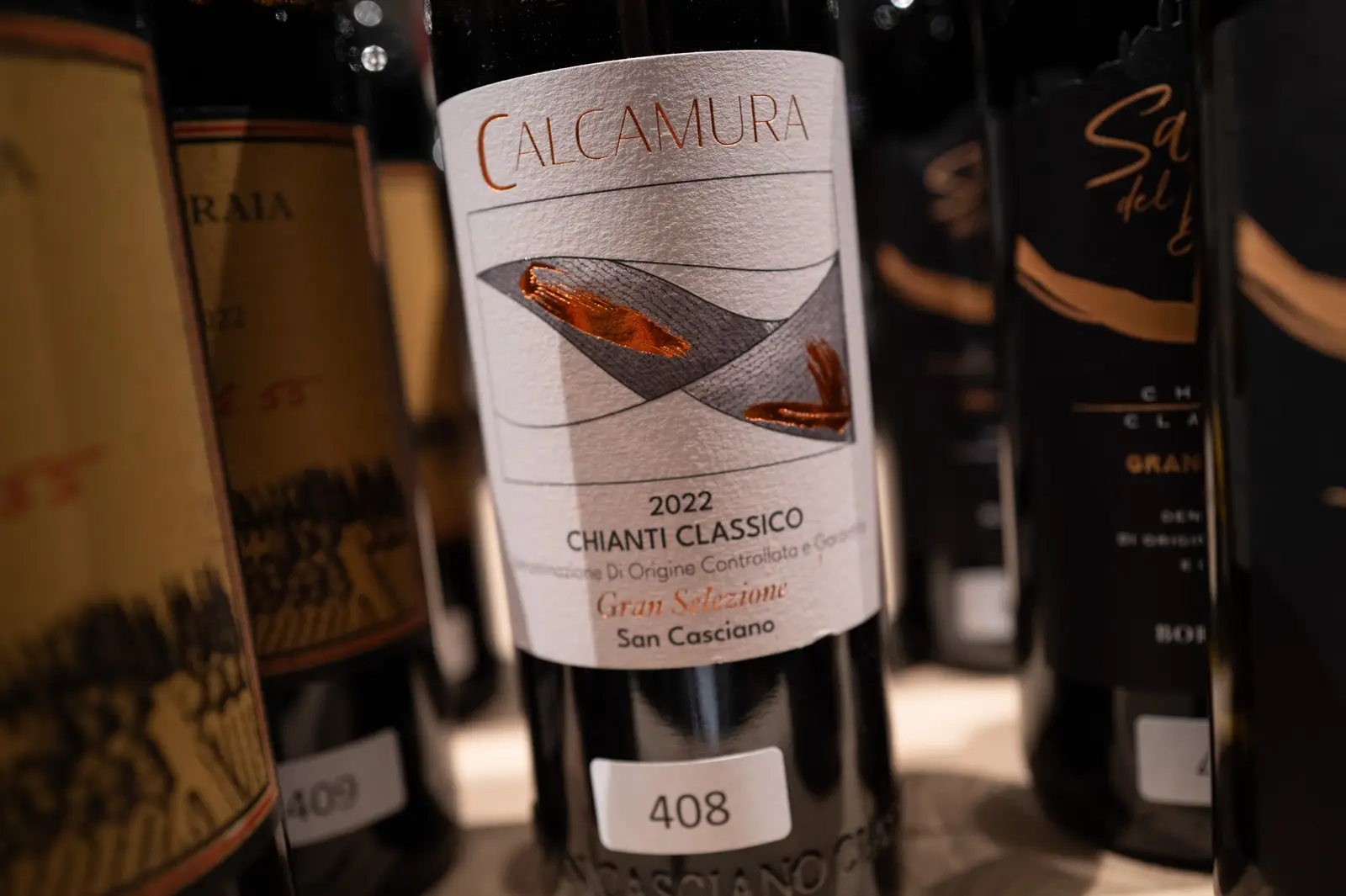
Most UGA-Centric: 2022 Calcamura Chianti Classico Gran Selezione
Another promise of the Gran Selezione category is to reveal (and revel in) the unique character of Chianti Classico’s codified zones, called UGA. This effort often centers on terroir, but eventually, I find that the culture of each zone is incredibly important.
San Casciano in Val di Pesa has long been overlooked. For one, it sits on the other side of the highway that connects Florence and Siena. Things feel different over here — it is a little more Mediterranean, the landscape less brooding and forested, more open to the sky. The subzone is indeed warmer, and with more alluvial deposits in the soil, yielding wines with a fruity character that often clashes with new oak. Sommelier Carlin Karr of Denver’s Tavernetta, was telling me that she’s noticed a trend of whole-cluster fermentation across the zone, which gives these wines lift and a playful spirit.
This would be one of those cultural hallmarks I was talking about earlier. There is a lot of “freestyle within the rules” going on in San Casciano, aided by young winemakers eager to make their mark and provide a younger vibe on what Chianti Classico can be.
Partners Stefano Marinari and Andreita Rojas are two such people. Stefano makes wine at Castello di Bossi. Andreita originally hails from Chile. Together as Calcamura, they’re working as micronegociants and making their wines in Radda at Istine (see below).
This marks the first Gran Selezione they’ve made, and it was so revealing to me of this UGA’s potential. The aromas alone were worth the admission: heavenly swirls of spearmint, orange peel and playful light cherries. Once the wine crossed my palate, I was struck by how lean and fine, silky and evocative everything was. This is a wine that is happy to be in your company. Could it be that San Casciano is a Chianti Classico that dances? I wrote in the margins. I will say that the tension in this wine didn’t seem to lend itself to long aging, but perhaps that’s beside the point in this zone. Time will tell.
Best Invitation to Visit Chianti: 2022 Querceto di Castellina “Sei” Chianti Classico Gran Selezione
I am going to step outside the confines of the tasting room for a minute to tell you about this next wine, because it underscores why I am now shifting a lot of my bandwidth to planning Italian wine vacations for my readers.
Once you experience a place, you will always taste its wines differently. And that’s OK. That’s as it should be.
What often goes unsaid in the annals upon annals of wine writing about Chianti Classico is the fresh air. I’ve written extensively about the intact forests that surround so many of the vineyards, and how they preserve biodiversity and regulate climate. In many ways, it is the greatest attribute of the area.
But when you are there, standing on the edge of a vineyard as the sun rises, you notice something else. Each inhale feels refreshing, peaceful and profound. When you have this much plant life surrounding you, you can feel it in the air. Do you feel this in Barolo? Or Etna? Somewhat, but not this much.
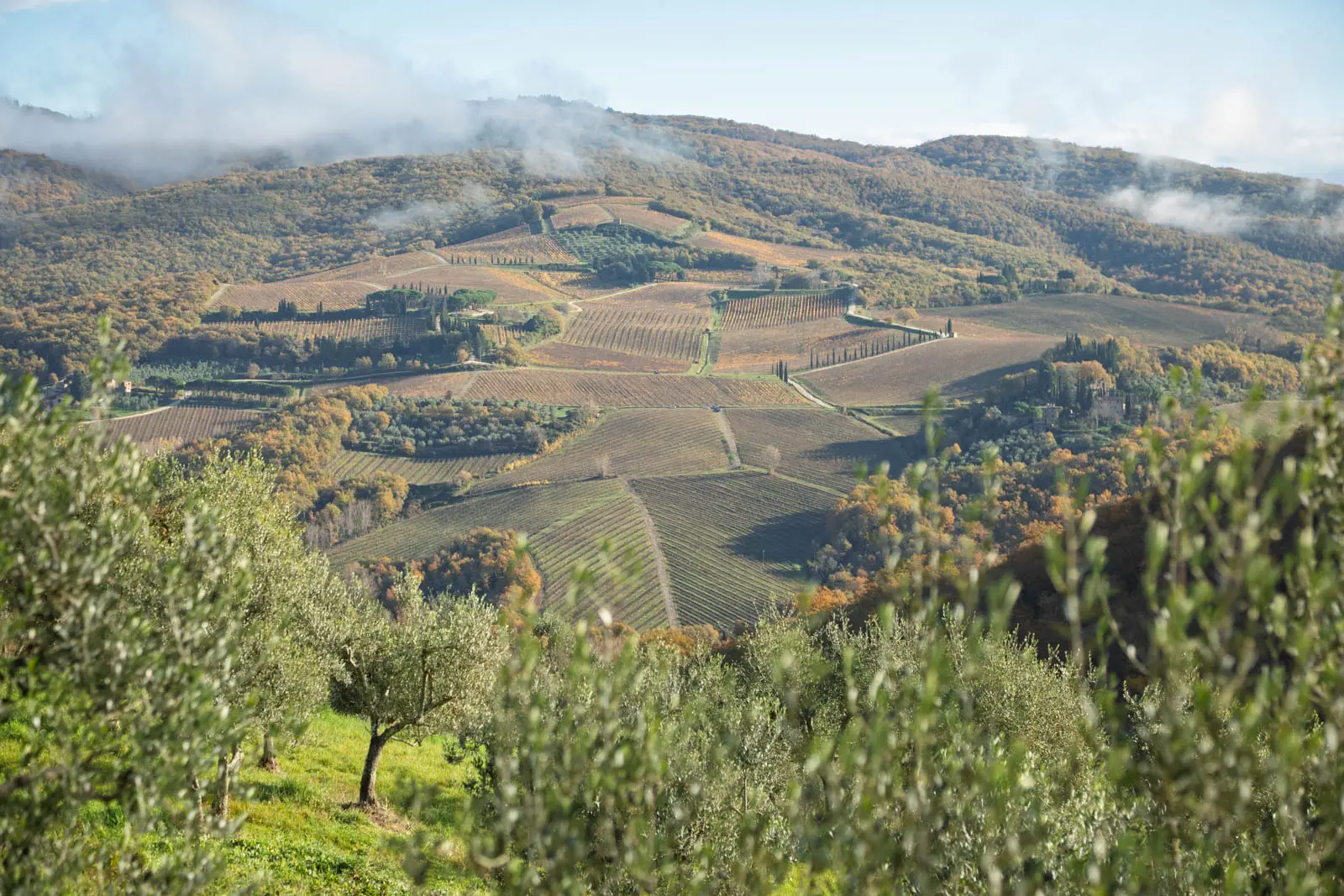
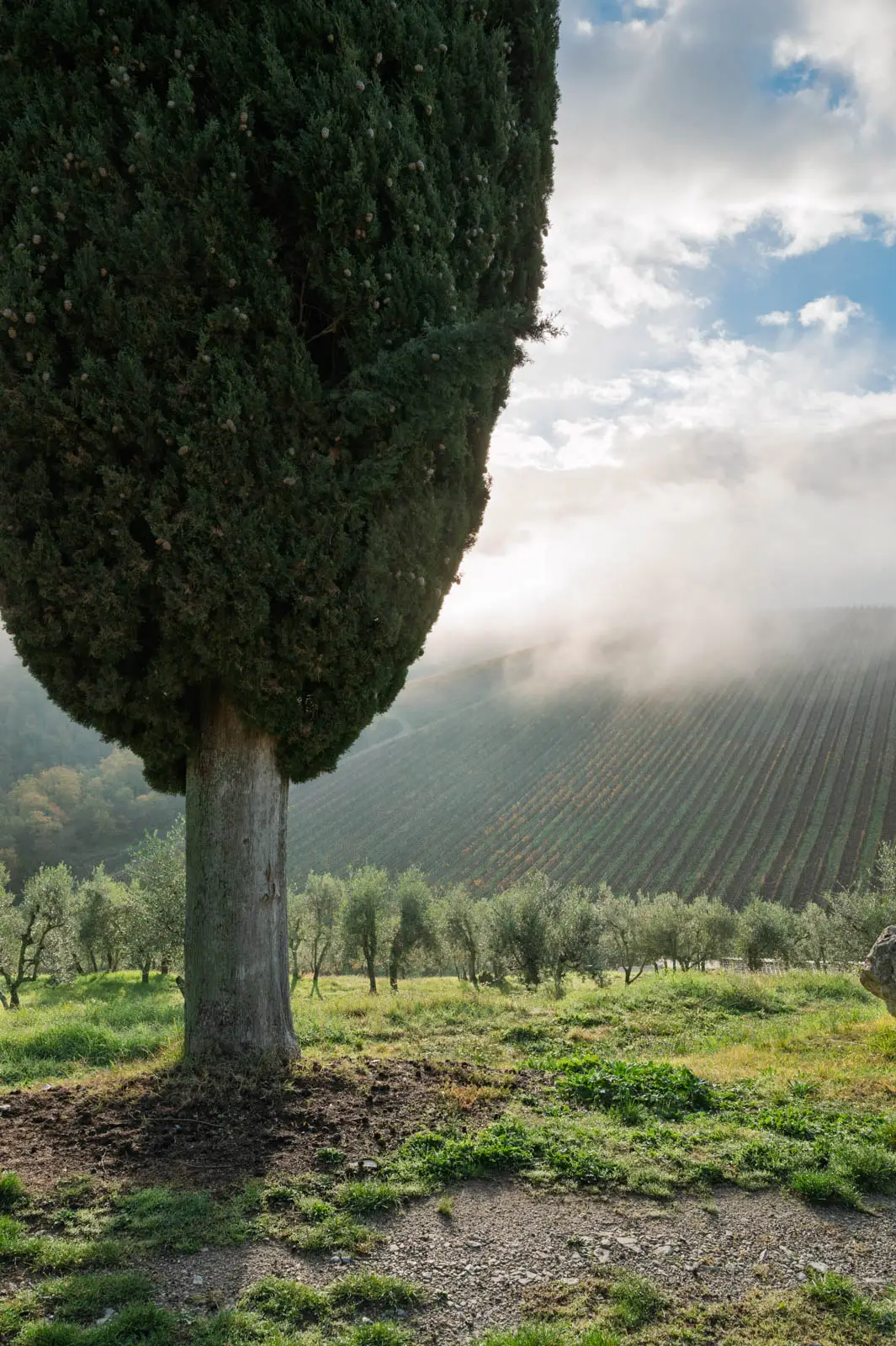
Last November, on a stopover before Benvenuto Brunello, I stayed as a guest in one of the apartments at Querceto di Castellina. Querceto means oak forest in the local dialect, and it is an appropriate tribute to the estate’s arboreal residents. In the morning, I awoke early to photograph the north-facing Vigna Belvedere and the estate’s stunning down-valley view of the vineyards and orchards of Lucarelli and Monterinaldi (see photos at left/bottom). Birdsong filled the air, and while I wished for a wool hat to keep my ears warm, I couldn’t remove myself from the scene.
So when I evaluated the estate’s wines at the Chianti Classico Collection in February, I was curious to see how influenced I’d be by my experience. I’d tasted a preview of the 2022 “Sei” at the estate, and what aligned at both sessions was the wine’s finesse. Winemaker Jacopo Di Battista and enologist Gioia Cresti managed to preserve a great deal of that fresh-air feeling in the 2022 vintage, which was no easy task given the heat and dryness of the vintage. The wine is sharp, quenching and fruit-driven, yet still amply detailed with layers of herbaceousness and coarse-cotton tannins.
Most Terroir-Driven: 2022 Castello di Volpaia “Il Puro – Casanova” Chianti Classico Gran Selezione
Perched high up in the mountains and fashioned from a restored village, this Radda estate deserves to be commended as one of Chianti Classico’s most consistent producers. Volpaia’s wines are never showy nor coarse in youth, and they’re never out of reach. They dazzle with their completeness.
The 2022 “Il Puro – Casanova” is the Gran Selezione vision realized. This specific parcel in Radda’s Campo di Berto has very old vines dating back to 1943. Incredibly, they are own-rooted, too. Whether this gives the fruit a sense of purity, as the name suggests, is a matter of opinion and poetry, but the 2022 certainly offers ample cherry- and currant-like character. The aromas recall crushed mint leaves and peppercorn, too, with savory traits lurking under the surface. It is one of the clearest identities of single-vineyard winemaking in Chianti Classico. The fact that the wine’s dazzling persistence and minerality is a consistent hallmark of the Radda UGA, only adds to its essential status.
The Returning Champ: 2022 Istine “Casanova dell’Aia” Chianti Classico Gran Selezione
Last year, I came away from the Chianti Classico Collection feeling like Istine’s Angela Fronti might be the best winemaker in the region. Her wines are always fresh, vivacious, complex and compelling. But so are many others. The difference lies in how Angela’s wines evolve in the glass like a good story. They’re warm-hearted, thoughtful and soulful — three traits you can’t manufacture in the vineyard and cellar without being a warm-hearted, thoughtful and soulful yourself.
Casanova dell’Aia hails from Radda, and it is one of three Gran Selezione that winemaker Angela makes. The 2022 offers ample savory and earthy tones, with a juniper-like herbaceousness carried on a lightweight frame of sour citrus and cherry-like fruit. The wine’s beautiful elegance calls for a Burgundian glass to fully appreciate its knack for unraveling a yarn from the vineyard. Like Volpaia’s “Il Puro – Casanova,” its minerality is pure Radda.
2021 Monteraponi “Bragantino” Chianti Classico Gran Selezione
The hype surrounding Monteraponi burns about as intensely as any winery in Tuscany. Michele Breganti is known for his assertive personality, unapologetic opinions and meticulous nature. When I visited his estate in 2022, he was holding out on the Gran Selezione category because, in his words, it didn’t go far enough in mandating 100% Sangiovese. Burgundy was clearly in his sights: they had become the apex of fine wine because people wanted to know the difference from one micro-plot to the next. They could only identify those differences through a varietal approach that leveled the playing field. Chianti Classico had extraordinary terroir and history. Why couldn’t it be the same way? It seemed like a source of frustration.

There was also an implication in our conversation that the Gran Selezioni needed to come up to his standards before he’d join, but he eventually did with this wine when the 2019 vintage debuted in 2024.
It is apparent with the 2021 Bragantino why Monteraponi is so esteemed. As the name suggests, the wine’s aromas possess a self confidence that is undeniable: bold, focused, and ridiculously compelling — like a star athlete who guarantees a Game 7 victory, then executes on the promise. The hints of cherry and cigar box underscore Monteraponi’s popularity: simply irresistible I wrote in my notes. But for me, the real magic lies in the precision of the tannins, which complement the momentous acidity beautifully. This is a wine made with high standards to back up an extravagant price that is now pushing the $300 mark. Italian wine aficionados with deep pockets don’t seem to mind, and they’ll find plenty to adore here with the 2021.
2022 Castello di Ama “San Lorenzo” Chianti Classico Gran Selezione
Castello di Ama has long been a darling of Chianti Classico lovers. For me, their reliance on Merlot in the final blend has slightly muddled the regional identity of their wines. Technically perfect and delicious? Yes. But less savory and herbal than what Chianti Classico does best.
With the 2022 San Lorenzo, that’s changed. Backed down to a mere 4 percent, Merlot’s spice seems to lift up the soul of Sangiovese, rather than subsume it. It is a welcome change, and as a result, I found this wine to be dazzling: bright, elegant, somewhat oaky, but no longer fleshy.
Beginning with the 2027 vintage, international grapes will no longer be allowed in the Gran Selezione category. The vision continues to get honed.
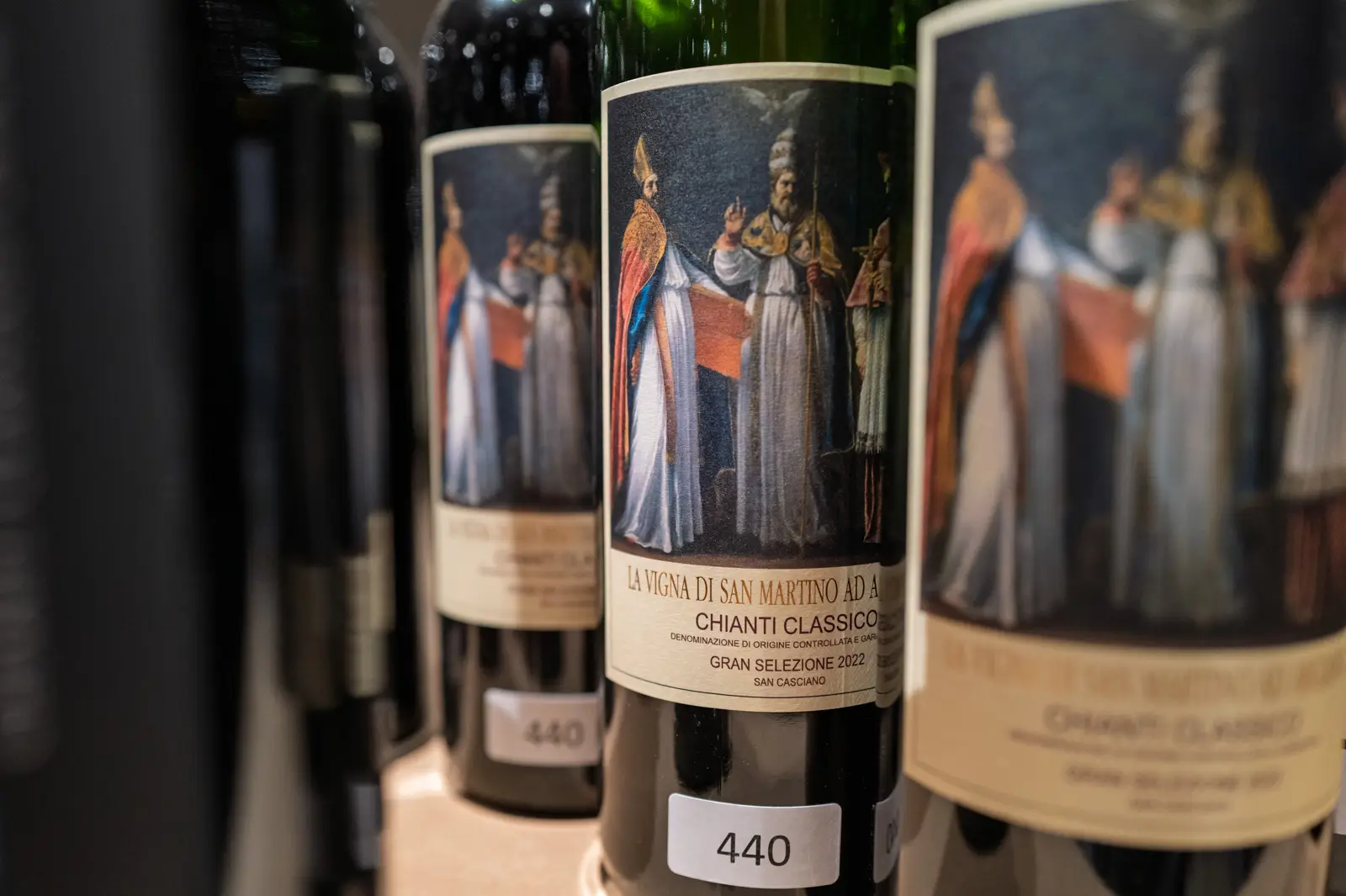
2022 La Vigna di San Martino ad Argiano Chianti Classico Gran Selezione
With so 223 participating estates and only two days time to taste them all, I inevitably miss a few each year — which is why I make a point of dedicating roughly 20% of my tasting schedule to producers I haven’t yet encountered. This year, La Vigna di San Martino ad Argiano was one of those wineries, and it turned out to be one of the most rewarding.
Like Calcamura, the vineyard land is situated in San Casciano Val di Pesa, but here it is owned by the Bishopric of Florence. Between the Riserva and the Gran Selezione, the estate offers a quietly compelling case for one of the appellation’s most overlooked UGAs. The Gran Selezione opens with fresh mint springs and dried cherries on the nose. What follows is vital and unique: energetic through its core, with fine-grained tannins and a long, leathery finish. Nothing here feels forced of style-chasing. This is a wine that was allowed to find itself, and it shows.
2021 Arillo in Terrabianca “Vigna Terrabianca” Chianti Classico Gran Selezione
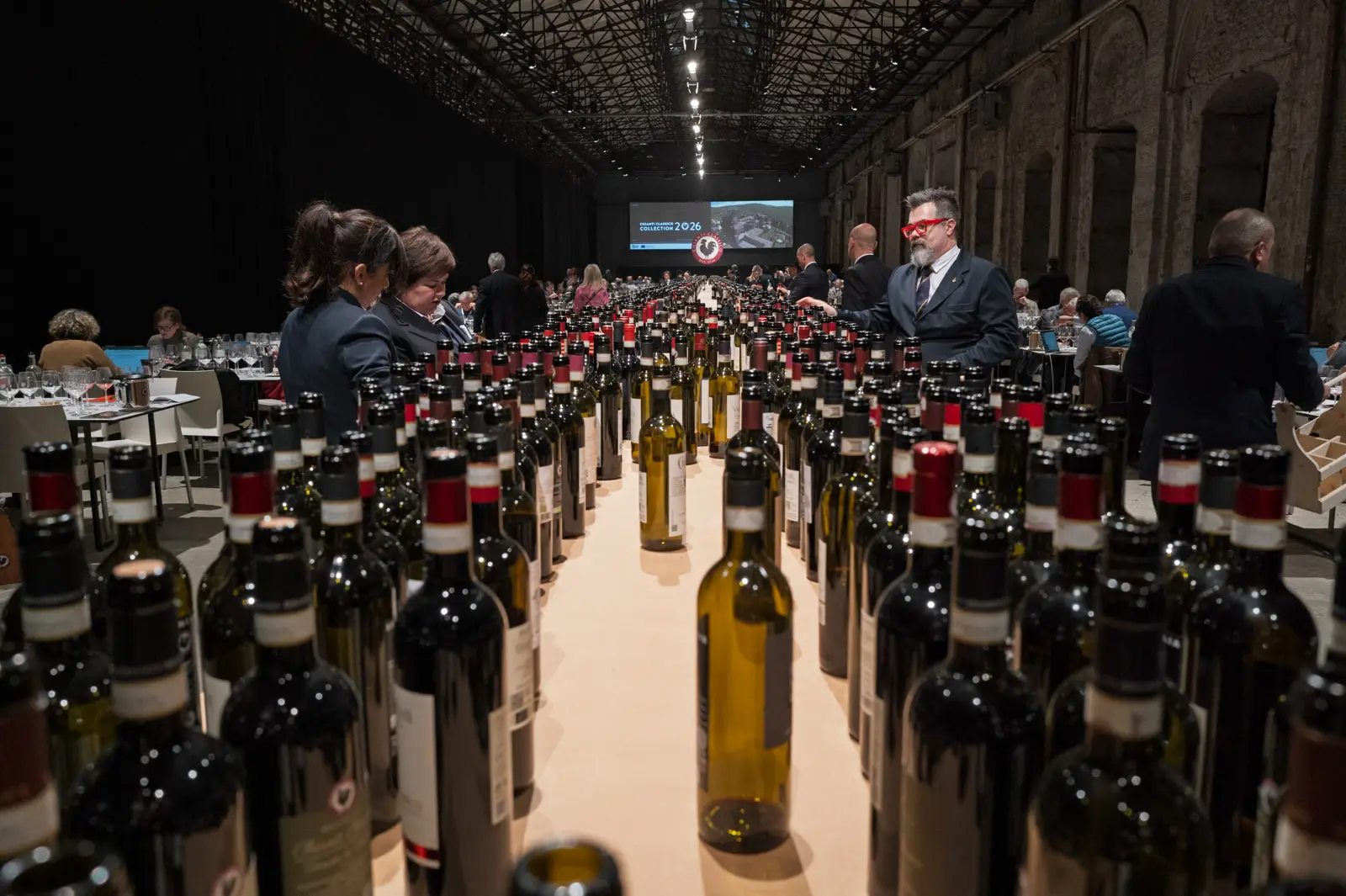
My process at this tasting was to taste each selected producer’s wines at once, in order from freshest to most structured: Annata, Riserva, Gran Selezione, next producer. Some flights of six were just two wineries, some flights of six were three wineries, as many still only make Annata and Riserva.
Often the wines feel like they’re part of a family; sometimes they don’t. I don’t hold it against estates that have a wild swing from one wine to the next, as long as each one is compelling.
With Arillo in Terrabianca, the shift from Riserva to Gran Selezione was one defined by a huge increase in earthy tones and an iron streak through the middle. Brooding and serious with a thorny disposition, this was a wine that knew what it stood for with dark fruit, resinous flavors, silky acidity, big alcohol and coarse cotton tannins. It will take a while for this wine to come around in the glass — give it at least two or three years — but based on the nose alone, I have a feeling it will be sumptuous.
2022 Fontodi “Vigna del Sorbo” Chianti Classico Gran Selezione
2022 Fontodi “Terrazze San Leolino” Chianti Classico Gran Selezione
2022 Fontodi “Pastrolo” Chianti Classico Gran Selezione
We conclude this report with another winery offering three different single vineyard wines with impeccable grace, agility and depth: Fontodi. For decades now, this estate has been the ambassador of the region thanks to the tireless advocacy of Giovanni Manetti, who has not shied away from putting Chianti Classico front and center on people’s minds. He has also been the President of the Consorzio for eight years now.
Vigna del Sorbo is the iconic wine here. This former-Riserva debuted in 1985 just as Fontodi’s rockstar Super Tuscan — “Flaccianello della Pieve” — was sending shockwaves through the Italian wine market. Vigna del Sorbo had some Cabernet Sauvignon in it at the time, which allowed international drinkers leery of Tuscany’s indigenous grapes a gradual introduction to its flavor spectrum. In 2014, Manetti threw his support behind the nascent Gran Selezione category by assigning it to Vigna del Sorbo. Around the same time, he made the wine as 100% Sangiovese.
The 2022 showcases its benchmark status beautifully with a big, fleshy disposition that speaks to the Conca d’Oro, the famous amphitheater of vines below Panzano where this microplot resides. Cigar box, black cherries and precision define its profile. Pastrolo resides on the other end of the spectrum with more lightness and citrus to its repertoire. However, I think it was Terrazze San Leolino that stood out most, for its intoxicatingly earthy aromas and pure fruit.
If there is a reason I give the trio from Villa Calcinaia higher marks than Fontodi, it would be that Fontodi’s wines are still fairly buttoned-up and conservative — a matter of taste only. But in their prudence, they are able to communicate to a broader swath of wine drinkers about the potential of Chianti Classico, and there is tremendous value in that.
Captions
From top to bottom (All photos ©Kevin Day/Opening a Bottle):
- The wines of Villa Calcinaia – Conte Capponi, the best ones from this year’s class of Gran Selezione
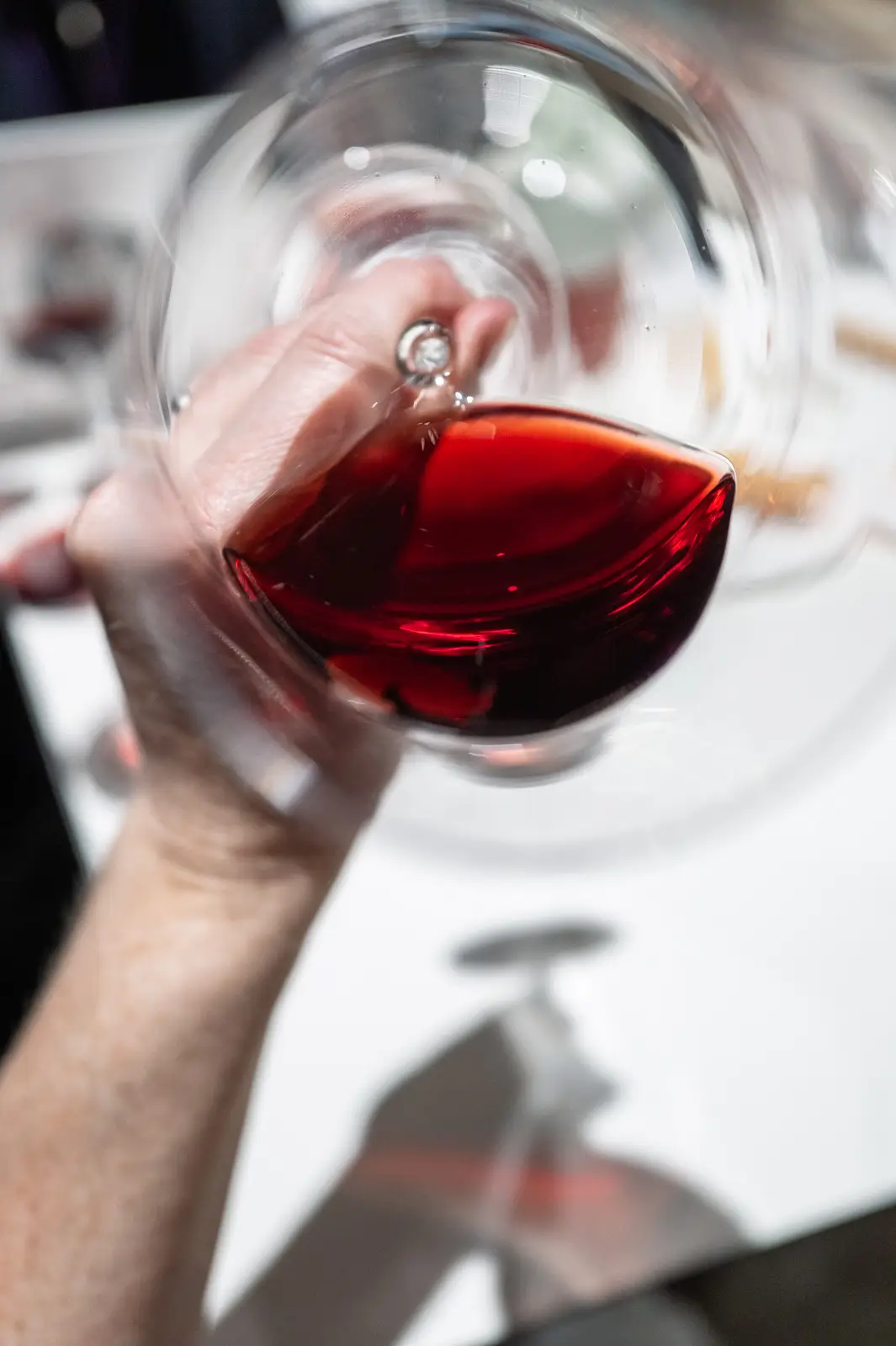
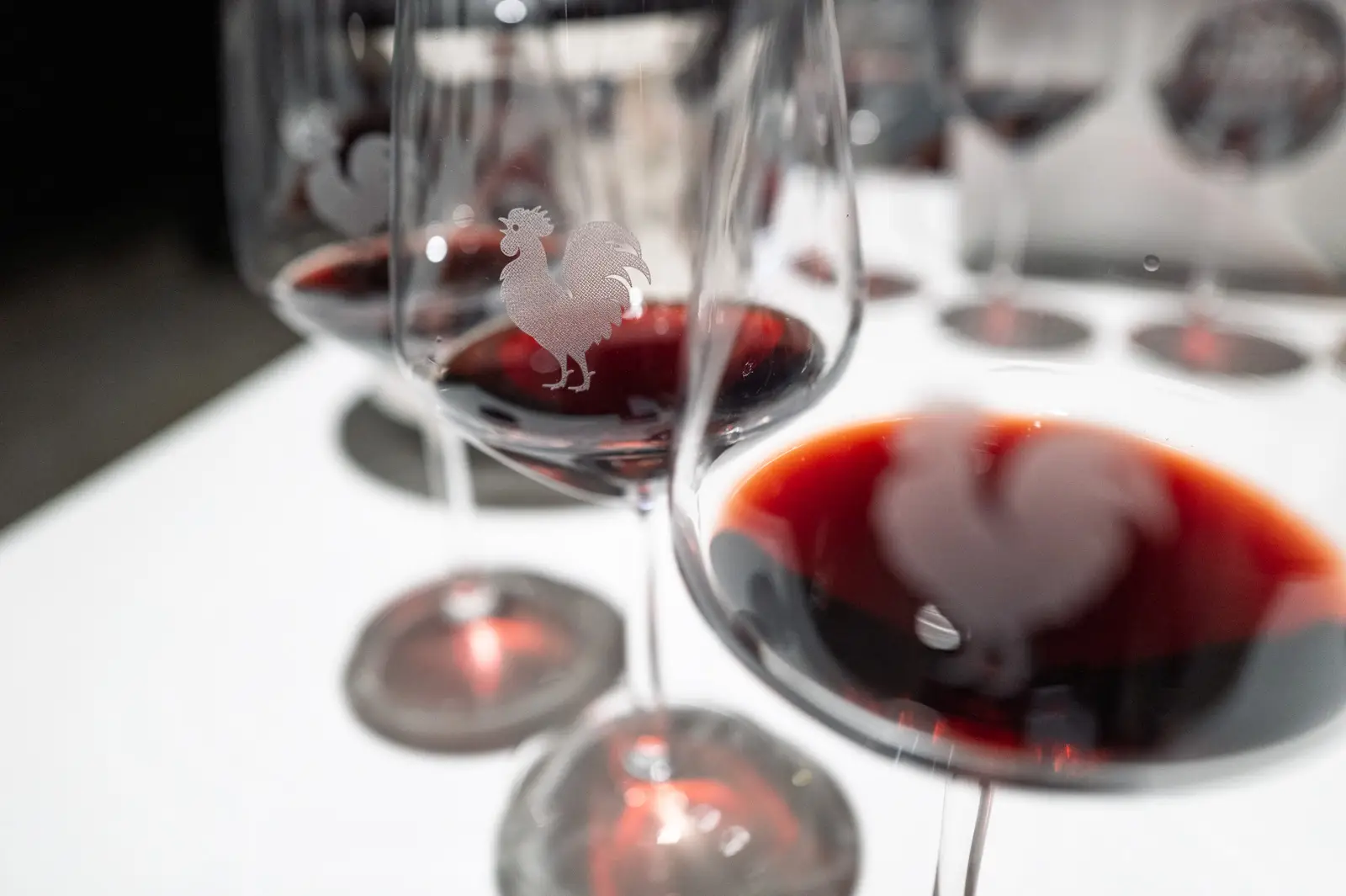
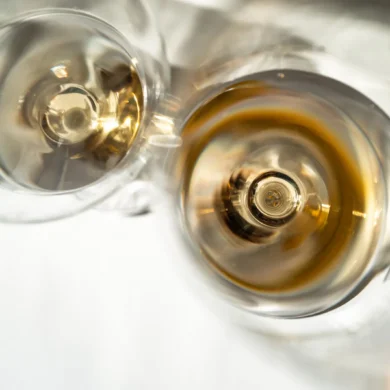
- What Gran Selezione ought to look like in the glass
- Winemaker Conte Sebastiano Capponi of Villa Calcinaia – Conte Capponi
- The view down valley from Querceto di Castellina
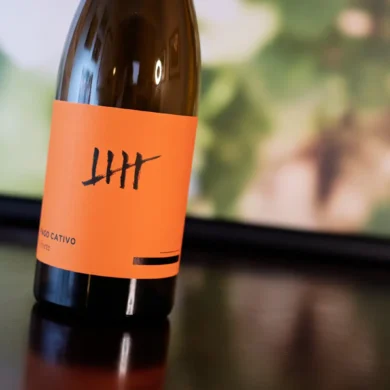
- Calcamura’s 2021 Chianti Classico Gran Selezione, a San Casciano in Val di Pesa wine that speaks to the value of the UGA system and its sense of place
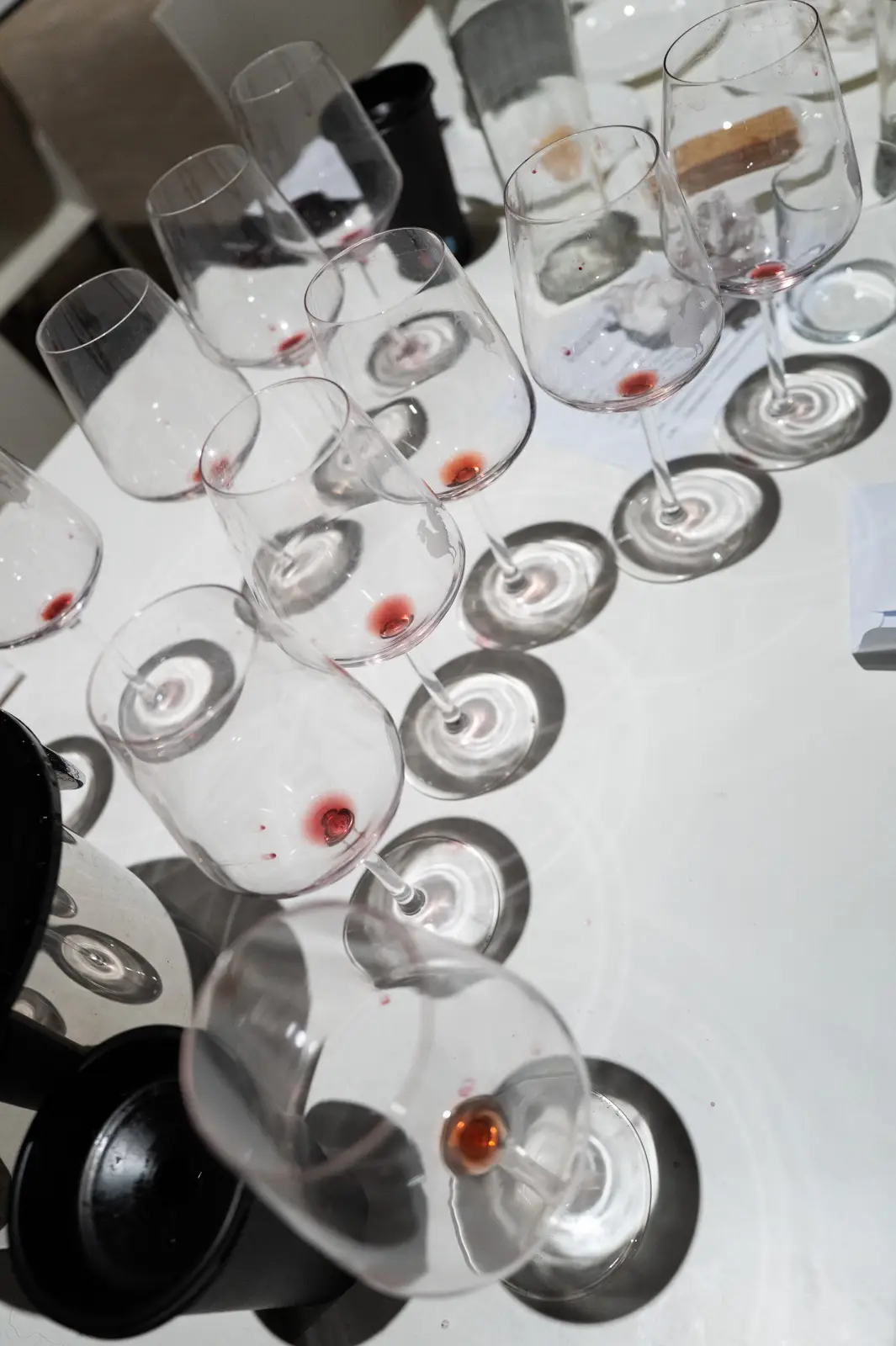
- Aftermath of a Gran Selezione tasting
- The 2020 Rocca di Montegrossi “San Marcellino” Chianti Classico Gran Selezione
- The 2022 La Vigna di San Martino ad Argiano Chianti Classico Gran Selezione
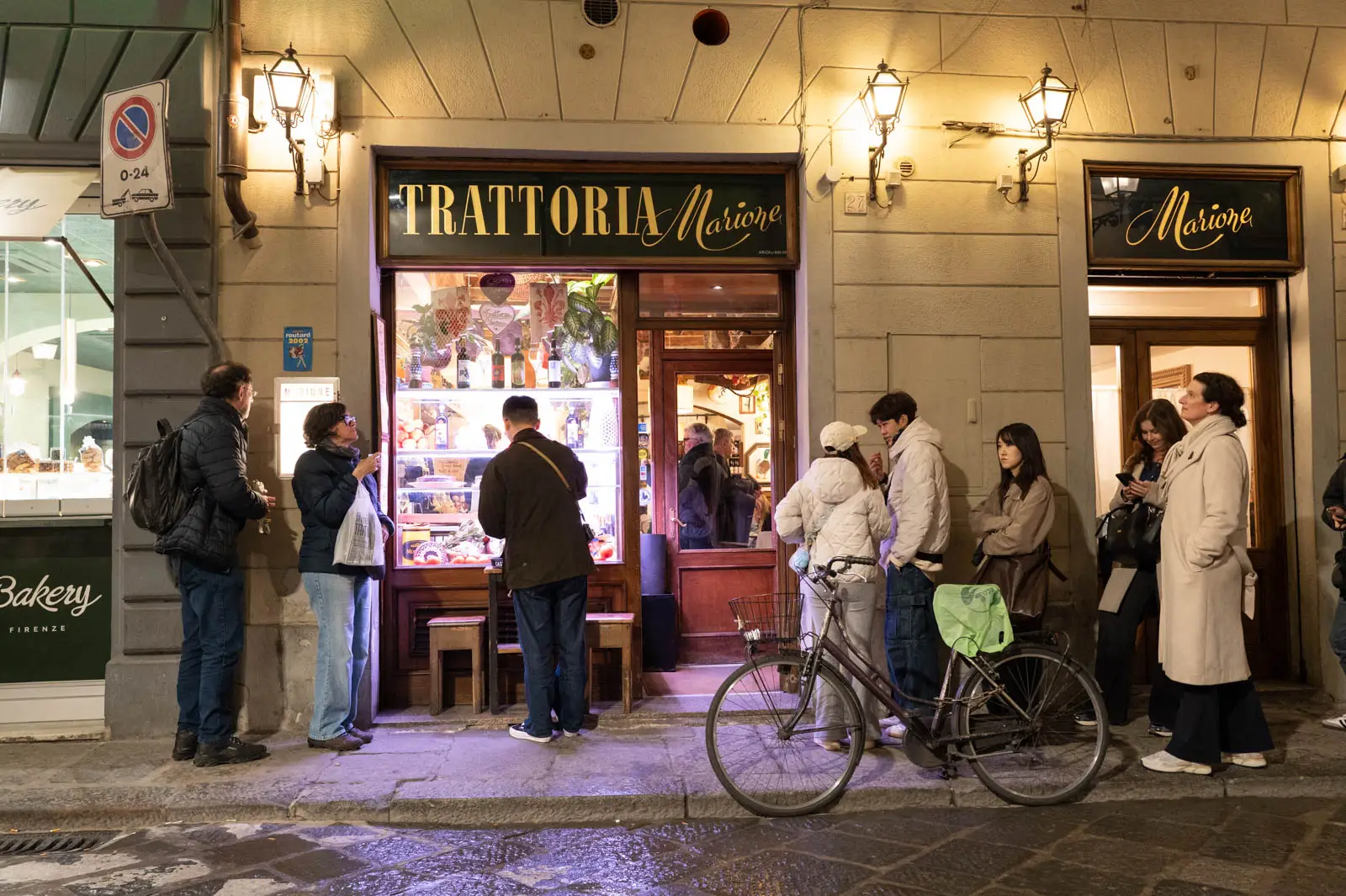
- Typical street scene in Florence, Italy, where the food is worth waiting in line for at all hours
- The Black Rooster (Ok, its white on the wine glass) is the official logo of Chianti Classico
- Dawn at Querceto di Castellina.
Note: My travel expenses to attend the Anteprima di Toscana were paid for by the governing body of the event. Learn more about my travel and editorial policy in producing this publication.